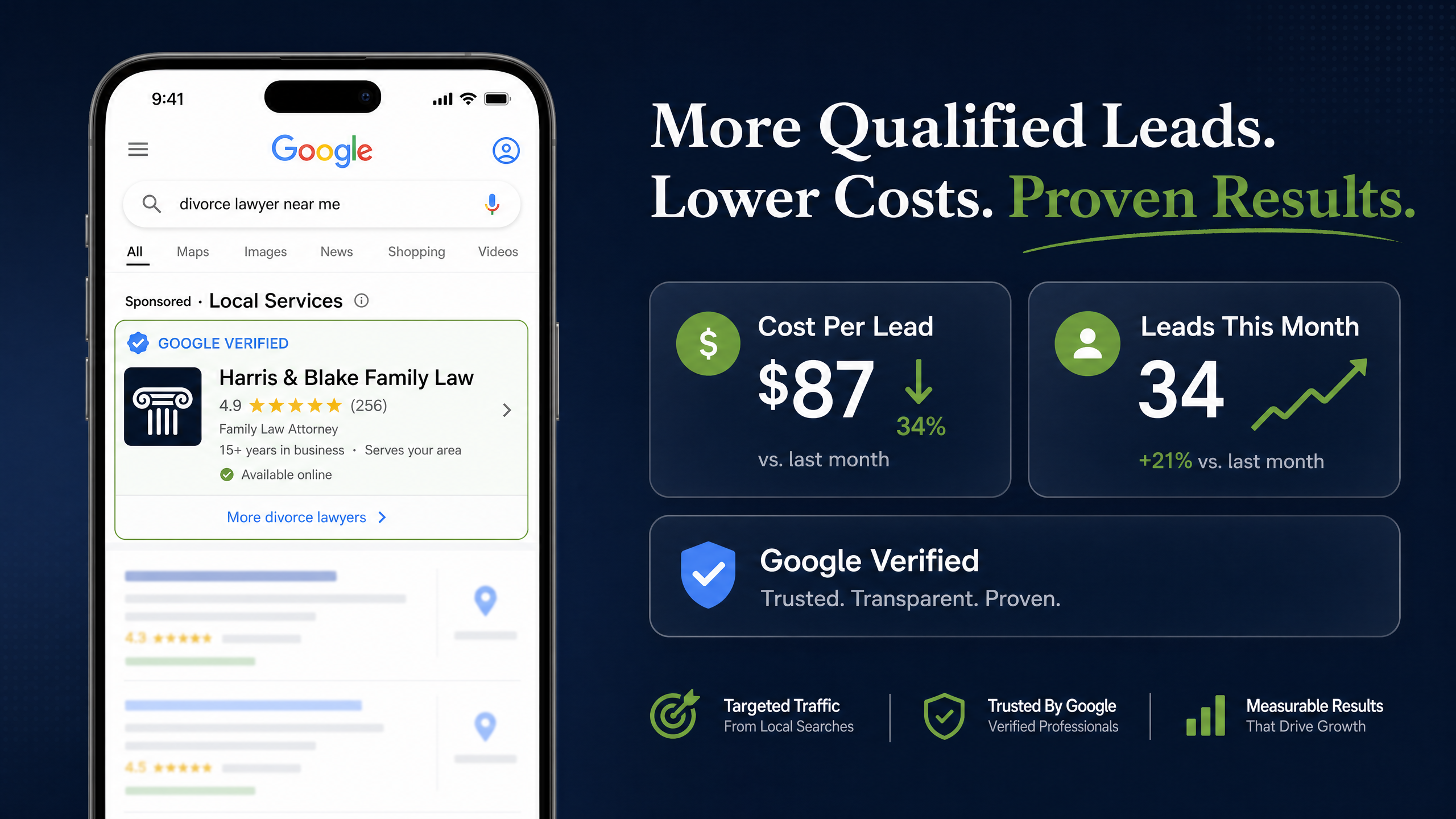
When someone in your city types “divorce lawyer near me” or “child custody attorney” into Google, the very first results they see are not organic listings. They are not even standard paid ads. They are Google Local Services Ads (LSAs) — a pay-per-lead format that places your firm at the absolute top of the page, above the map pack and above every other form of advertising Google offers.
For family law firms, this placement is enormously valuable. People searching for a divorce attorney or a custody lawyer are not browsing casually. They are in the middle of a life-altering situation and they are ready to hire. LSAs put your firm directly in front of that intent at the exact moment it exists. This guide covers everything you need to know to get started, get verified, and get the most out of your investment.
What Are Google Local Services Ads?
Google Local Services Ads are a distinct advertising product designed specifically for local service businesses. Unlike traditional Google Ads, which charge you every time someone clicks your ad regardless of what happens next, LSAs operate on a pay-per-lead model. You only pay when a prospective client actually calls your firm or sends a message directly through the ad. Clicks that do not result in a contact cost you nothing.
The placement is equally important. LSAs appear at the very top of Google search results — above the local map pack, above standard PPC ads, and above all organic listings. On mobile, which is where the majority of legal searches now originate, LSAs often dominate the entire visible screen before a user scrolls at all. This is premium real estate, and it is available to family law firms in most major markets across the United States.
Key distinction: LSAs are not the same as standard Google Ads. They are a separate product with a separate account, a separate billing model, and a separate verification process. Many firms run both simultaneously for maximum coverage.
LSAs vs. Standard PPC: What Is the Difference?
Family law firms often ask whether they should invest in LSAs, standard PPC campaigns, or both. The answer depends on your goals and budget, but understanding the structural differences helps clarify the decision.
| Feature | Local Services Ads | Standard PPC (Google Ads) |
|---|---|---|
| Billing model | Pay per lead (call or message) | Pay per click |
| Ad placement | Above map pack and all ads | Below LSAs, above organic |
| Verification required | Yes — Google Verified badge | No |
| Trust signal displayed | Google Verified blue checkmark | None |
| Reviews shown in ad | Yes — star rating and count | No (unless extensions added) |
| Budget control | Weekly budget, pause anytime | Daily budget, keyword-level control |
| Lead disputing | Yes — invalid leads can be disputed | No |
The most strategic approach for most family law firms is to run LSAs and standard PPC in tandem. LSAs capture the highest-intent, ready-to-hire searches at the top of the page. Standard PPC fills in the gaps with broader keyword targeting, remarketing, and more granular audience controls. Together, they create a dominant presence across the entire paid search landscape.
The Google Verified Badge: What Family Law Firms Need to Know
One of the most important developments in the LSA ecosystem happened on October 27, 2025, when Google retired its existing trust badges — including the Google Screened checkmark that attorneys had earned for years — and replaced them with a single, unified Google Verified badge. This blue checkmark now appears on all eligible LSA profiles across every professional service category, including legal.
If your firm already had the Google Screened badge, Google automatically migrated your profile to the new Google Verified badge. No action was required. However, if you are new to LSAs or have not yet completed the verification process, you will need to go through the following steps to earn the badge.
How to Qualify for the Google Verified Badge
The verification process is straightforward but requires documentation and patience. Google typically takes three to four weeks to complete its review after you submit all required materials. Here is what you need to provide:
- Create your LSA account. Sign up at the Google Local Services Ads platform and select “Family Law” (or the relevant legal practice area) as your service category. Define the geographic area you serve.
- Verify attorney identities. Each attorney who will appear in your ads must have their identity confirmed. Google uses authorized screening partners to complete this step.
- Provide active bar license documentation. Every attorney listed in the account must submit proof of an active state bar license in good standing. This effectively serves as a background check, since bar admission already requires vetting.
- Submit proof of professional liability insurance. Your firm must carry active malpractice or professional liability insurance, and you must provide documentation to Google. If your policy is approaching expiration, update Google at least one month in advance to avoid any interruption to your ads.
- Meet the review threshold. Google requires a minimum number of client reviews on your profile before your ads can display the Verified badge. For most legal practice areas, at least one review is required to start, though some categories require more. If your firm is new to LSAs, proactively reach out to satisfied clients and ask them to leave a Google review.
Once all requirements are met and Google completes its review, the blue Google Verified checkmark will appear automatically on your LSA profile. From that point forward, maintaining the badge simply means keeping your licenses and insurance current and updating your profile whenever attorneys join or leave the firm.
Why LSAs Are Particularly Powerful for Family Law
Not all practice areas benefit equally from LSAs. Family law is one of the strongest fits for several reasons that are worth understanding before you invest.
High-Intent, Emotionally Driven Searches
People searching for a divorce attorney or a child custody lawyer are not in the research phase. They are in a moment of genuine urgency. The decision to search for legal help in a family matter is often made after weeks or months of deliberation, and when someone finally types that query into Google, they are ready to take action. LSAs intercept that moment at the top of the page, before any other result, with your firm’s name, star rating, and phone number immediately visible.
Local Intent Is Built In
Family law is inherently local. Clients want an attorney who practices in their jurisdiction, understands local court procedures, and is accessible for in-person consultations. LSAs are designed specifically for local service delivery, and Google’s algorithm surfaces your ads to users in your defined service area. This means your budget is not being spent on impressions or clicks from people outside your market.
The Google Verified Badge Builds Immediate Trust
Hiring a family law attorney is one of the most personal and consequential decisions a person can make. Trust is a primary factor in the selection process. The Google Verified badge communicates to prospective clients that your firm has been vetted by Google — that your attorneys are licensed, your insurance is current, and your business is legitimate. In a category where clients are already anxious and uncertain, that signal matters.
Reviews Are Displayed Directly in the Ad
Your Google star rating and review count appear prominently within your LSA. A firm with 4.8 stars and 60 reviews will consistently outperform a competitor with 3.9 stars and 12 reviews, even if the competitor bids more aggressively. This means that your investment in client satisfaction and review generation directly translates into better LSA performance — a virtuous cycle that compounds over time.
What Do LSAs Cost for Family Law Firms?
LSA costs vary by market, competition level, and practice area. Because you pay per lead rather than per click, the relevant metric is cost per lead (CPL) rather than cost per click. For family law, CPL typically falls in the range of $50 to $150 per lead in most markets, though highly competitive metropolitan areas can push that figure higher.
It is important to distinguish between cost per lead and cost per signed client. If your intake process converts 30% of LSA leads into retained clients, and your average CPL is $100, your effective cost per new client is approximately $333. For a family law matter with an average retainer of $3,500 to $7,500, that is an exceptional return on investment.
Important: You can dispute invalid leads directly in your LSA dashboard. If a lead is clearly spam, is outside your practice area, or is a wrong number, you can request a credit. Google reviews disputes and issues credits for leads that do not meet its quality standards. This is a meaningful cost-control mechanism that many firms underutilize.
Budget flexibility is another advantage of LSAs. You set a weekly budget, and Google will not exceed it. You can pause your ads entirely when your caseload is full, during vacations, or during periods when your intake team is understaffed. This level of control is more straightforward than managing keyword-level bids in a standard PPC campaign.
Setting Up Your Family Law LSA Account
Getting started with LSAs requires creating a separate account from your standard Google Ads account. The setup process walks you through the key configuration decisions that will shape your campaign’s performance from day one.
Define Your Service Area Carefully
Your service area determines which users will see your ads. Be specific and realistic. If your firm primarily serves clients within a 30-mile radius of your office, configure your service area accordingly. Expanding too broadly will dilute your budget with leads from areas you do not effectively serve. Conversely, being too restrictive can limit your reach in a market where clients regularly travel for legal services.
Select the Right Service Categories
Within the family law category, Google allows you to specify the types of services you offer. Common selections for family law firms include divorce, child custody, child support, adoption, domestic violence, prenuptial agreements, and legal separation. Select only the categories that reflect your actual practice. Mismatched categories generate low-quality leads and can hurt your ranking within the LSA system.
Optimize Your Business Profile
Your LSA profile is the face of your firm within the ad unit. Upload a professional photo of your office or your primary attorney. Write a compelling business description that clearly communicates your focus areas and what differentiates your firm. Ensure your phone number, address, and hours of operation are accurate and consistent with your Google Business Profile.
Connect Your Google Business Profile
LSAs pull review data directly from your Google Business Profile. If your GBP is not already optimized and populated with reviews, address that before launching your LSA campaign. The two products are deeply interconnected, and a weak GBP will undermine your LSA performance regardless of how well the rest of your account is configured.
Optimization Strategies That Move the Needle
Getting your LSA account live is just the beginning. The firms that generate the best results from LSAs are the ones that treat the platform as an ongoing investment requiring active management, not a set-it-and-forget-it tool.
Respond to Leads Immediately
Google’s LSA ranking algorithm rewards responsiveness. Firms that respond to leads quickly — ideally within minutes — are ranked higher in the ad unit than firms that let leads sit unanswered. Beyond the algorithmic benefit, speed-to-lead is one of the most powerful conversion drivers in legal marketing. Studies consistently show that the probability of converting a lead drops dramatically after the first five minutes. Train your intake team to treat LSA leads as the highest-priority contacts in your pipeline.
Manage Your Reviews Proactively
Your star rating is one of the most visible elements of your LSA. Make it a standard part of your client offboarding process to ask satisfied clients for a Google review. A simple, personalized follow-up message after a successful matter resolution is often all it takes. Do not wait for reviews to accumulate organically — build a systematic process around generating them. Even moving from 4.2 to 4.7 stars can meaningfully improve your click-through rate and lead volume.
Dispute Invalid Leads Consistently
Not every lead that comes through your LSA will be legitimate. Spam calls, wrong numbers, calls from people seeking services outside your practice area, and calls from existing clients all represent potential disputes. Log into your LSA dashboard regularly and dispute any lead that does not meet Google’s quality criteria. This reduces your effective cost per lead and signals to Google that you are an engaged advertiser.
Keep Your Profile Current
Update your LSA profile whenever something changes at your firm. If a new attorney joins, add them and submit their bar license for verification. If an attorney departs, remove their information promptly. Update your hours, service area, and contact information whenever they change. An outdated profile can trigger compliance flags that temporarily pause your ads.
Monitor Your Budget and Adjust Seasonally
Family law demand has seasonal patterns. Divorce filings tend to spike in January and after summer vacations. Custody matters often intensify around school year transitions. Align your LSA budget with these patterns, increasing spend during peak periods and pulling back when your caseload is at capacity. The ability to adjust your weekly budget in real time is one of LSAs’ most practical advantages.
Common Mistakes Family Law Firms Make With LSAs
After working with family law firms on LSA campaigns for years, certain patterns of underperformance emerge consistently. Avoiding these mistakes can save you significant budget and accelerate your results.
Setting the budget too low. LSAs require a minimum level of investment to generate meaningful lead volume. A weekly budget that produces only two or three leads per week does not give you enough data to optimize, and it limits your visibility in competitive markets. Work with a specialist to determine the appropriate budget for your market and goals.
Ignoring the review component. Firms that launch LSAs without a strong review foundation consistently underperform against competitors who have invested in their Google Business Profile reputation. Reviews are not a nice-to-have in LSAs — they are a core ranking and conversion factor.
Slow lead response. If your intake team is not equipped to respond to LSA leads within minutes, you are paying for leads that your competitors are converting. Before investing heavily in LSAs, ensure your intake process is optimized for speed and empathy.
Failing to dispute invalid leads. Many firms never open their LSA dashboard after the initial setup. This means they are paying for spam calls, wrong numbers, and out-of-area inquiries that should have been disputed. Regular account management is essential.
Not running LSAs and PPC together. LSAs and standard Google Ads serve different but complementary functions. Running only one channel leaves significant coverage gaps. The firms that dominate local search results typically run both, with a coordinated strategy that maximizes visibility across the entire paid search landscape.
How LegalScapes Manages LSAs for Family Law Firms
LegalScapes has managed Google Local Services Ads for family law firms across the United States since the platform launched. Our team handles every aspect of LSA management — from initial account setup and Google Verified badge qualification to ongoing lead review, dispute management, budget optimization, and performance reporting.
We bring the same exclusive focus to LSAs that we bring to every service we offer: we work only with law firms, which means our benchmarks, our optimization strategies, and our understanding of what a high-quality family law lead looks like are all calibrated specifically for your practice area. We do not apply generic digital marketing frameworks to legal advertising. We apply 13 years of experience working exclusively with attorneys.
If your family law firm is not currently running LSAs, or if your existing campaigns are not delivering the results you expect, we would welcome the opportunity to review your account and share what we are seeing in your market. Get a complimentary growth audit with our team and we will come prepared with a full audit of your current digital presence.