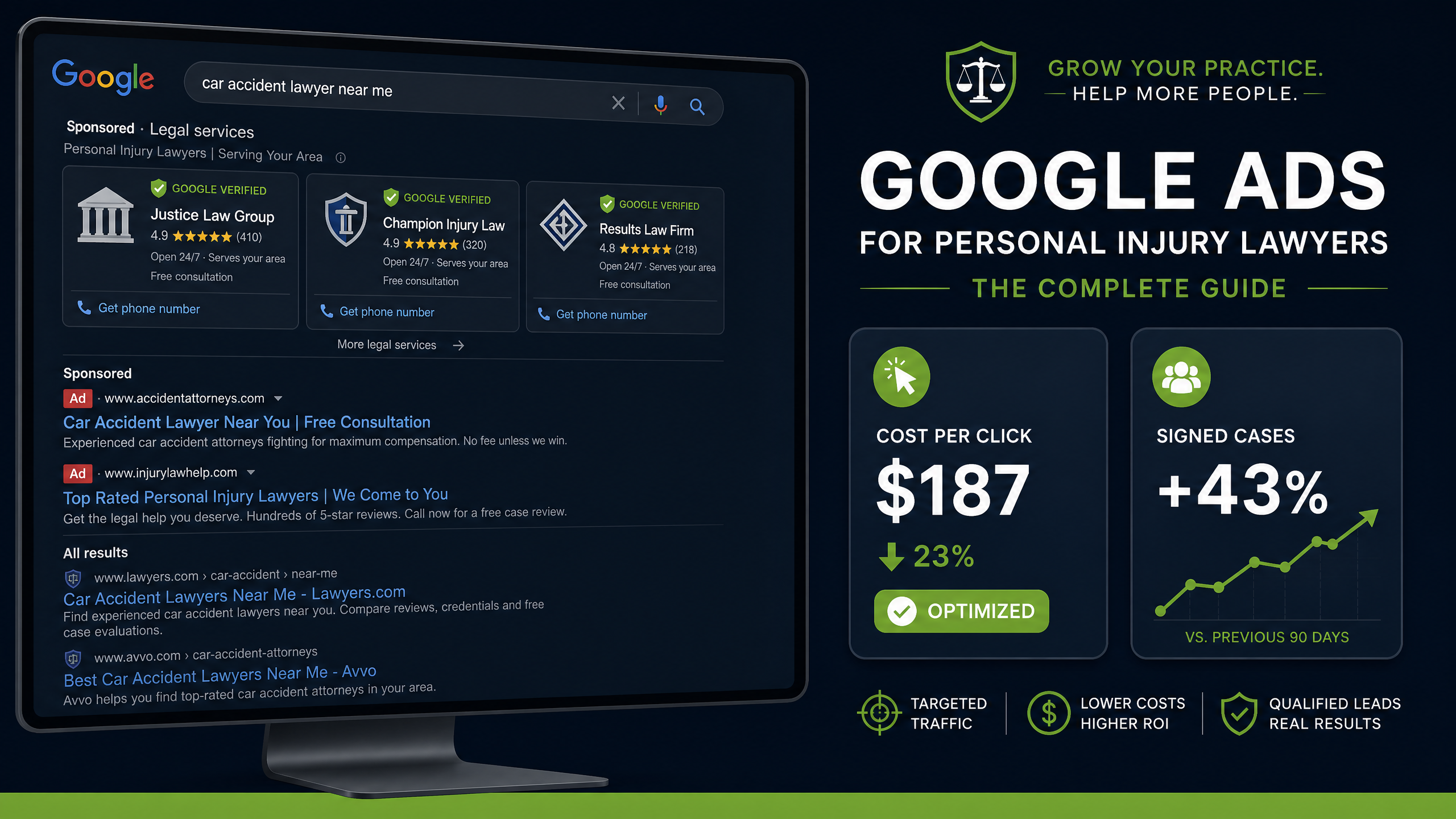
Personal injury is not just a competitive Google Ads vertical — it is the most competitive legal vertical in the country, and one of the most competitive across any industry. Cost-per-click figures regularly exceed $100 in major markets, and in cities like Los Angeles, New York, or Miami, a single click on a broad match keyword can cost $300 or more. Firms that run these campaigns without a disciplined strategy do not just underperform — they hemorrhage budget with very little to show for it.
At LegalScapes, we manage over $10 million per year in Google Ads spend for personal injury and other consumer-facing law firms. This guide distills what we have learned about what actually works: the campaign structures that produce signed cases, the mistakes that quietly drain budgets, the meaningful differences between LSAs and traditional PPC, and why where you send traffic matters as much as the ad itself.
LSAs vs. Traditional Google Ads: Understanding the Difference
Before discussing best practices for traditional Google Ads, it is worth clarifying how Local Services Ads fit into the picture — because the two products are fundamentally different, and confusing them leads to poor strategy decisions.
| Factor | Local Services Ads (LSA) | Traditional Google Ads (PPC) |
|---|---|---|
| Placement | Above everything — map pack, PPC, organic | Below LSAs, above organic results |
| Billing model | Pay per lead (call or message) | Pay per click |
| Trust signal | Google Verified badge + star rating | None by default |
| Budget control | Weekly budget, limited targeting | Daily budget, full keyword and audience control |
| Scalability | Limited by weekly lead caps | Effectively unlimited |
| Landing page control | None — leads go to your profile | Full — you choose the destination URL |
| Lead disputing | Yes — invalid leads can be credited | No |
| Best for | High-intent local searches, trust building | Scale, specific case types, remarketing |
LSAs are powerful for personal injury because they sit above everything else on the page and carry the Google Verified badge, which signals credibility to someone in a stressful, urgent situation. However, LSAs have real limitations: you cannot control which keywords trigger your ads, you cannot target specific case types, and weekly lead caps mean you cannot simply increase spend to get more volume.
Traditional Google Ads give you complete control. You can build separate campaigns for car accidents, truck accidents, slip and fall, workers’ compensation, and wrongful death — each with its own keywords, bids, ad copy, and landing pages. You can run remarketing campaigns to re-engage people who visited your site but did not call. You can target by device, time of day, geographic radius, and audience segment. For firms serious about scaling their caseload, traditional PPC is not optional — it is the engine.
The right answer for most PI firms: Run both. LSAs capture the highest-intent local searches at the top of the page. Traditional PPC fills in the gaps, targets specific case types, and provides the scale and control that LSAs cannot.
Campaign Structure: How to Organize Your Google Ads Account
One of the most consequential decisions in a personal injury Google Ads account is how campaigns are structured. A poorly structured account forces high-value and low-value keywords to compete for the same budget, makes optimization nearly impossible, and obscures the data you need to make good decisions.
Separate Campaigns by Case Type
The single most important structural principle is to give each major case type its own campaign. At minimum, a well-structured PI account should have separate campaigns for:
- Car accidents (the highest volume and often the highest competition)
- Truck and commercial vehicle accidents (higher case values, different keyword intent)
- Motorcycle accidents
- Slip and fall / premises liability
- Workers’ compensation (if your firm handles these)
- Wrongful death
- Medical malpractice (if applicable)
Separating by case type allows you to set different bids based on the value of each case type, write ad copy that speaks directly to the specific situation the searcher is in, send traffic to a dedicated landing page for that case type, and see clearly which case types are generating leads and at what cost.
Match Types and Keyword Strategy
Personal injury keyword strategy requires a careful balance between reach and precision. Broad match keywords will generate volume, but in a vertical where clicks cost $100–$300, every irrelevant click is a significant waste. The recommended approach is to lead with phrase match and exact match keywords for your highest-value terms, use broad match sparingly and only with Smart Bidding strategies that have sufficient conversion data to guide them, and build a robust negative keyword list from day one.
Negative keywords are not optional in personal injury PPC — they are essential. Without them, your ads will appear for searches like “personal injury lawyer salary,” “personal injury law school,” “personal injury claim against me,” and dozens of other irrelevant queries that will never produce a client. Build your negative keyword list before the campaign launches and review the search terms report weekly for the first several months.
Landing Pages vs. Homepage: Where You Send Traffic Matters Enormously
This is one of the most common and most costly mistakes we see in personal injury Google Ads campaigns: sending paid traffic to the firm’s homepage. It seems logical — the homepage is the most comprehensive page on the site, it has all the firm’s information, and it looks professional. But it is almost always the wrong destination for paid traffic, and here is why.
Why the Homepage Fails as a Landing Page
When someone searches “car accident lawyer in [city]” and clicks your ad, they have a very specific need in a very specific moment. They were just in an accident, or they are dealing with the aftermath of one. They are not browsing. They are evaluating whether to call you right now.
Your homepage is designed for a general audience. It talks about all of your practice areas, your firm history, your team, your awards, and your philosophy. It has navigation that invites people to explore. All of that is appropriate for someone who found you through organic search or a referral and wants to learn more about your firm. It is not appropriate for someone who just clicked a $150 ad and needs to be immediately convinced to pick up the phone.
A dedicated landing page, by contrast, is built for one purpose: converting that specific visitor. It speaks directly to their situation, it eliminates distractions, and it makes the next step — calling or submitting a form — as easy and compelling as possible.
What a High-Converting PI Landing Page Includes
An effective personal injury landing page for paid traffic should include the following elements:
- A headline that matches the ad. If your ad says “Car Accident Lawyer — Free Consultation,” your landing page headline should immediately reinforce that message. Message match between ad and landing page is one of the strongest drivers of conversion rate.
- A prominent phone number above the fold. On mobile, this should be a click-to-call link. The phone number should be large, visible without scrolling, and ideally repeated multiple times on the page.
- A short, simple intake form. Ask for name, phone number, and a brief description of the accident. Do not ask for more than you need. Every additional field reduces form completion rates.
- Social proof near the top. A star rating, a client testimonial, or a line like “Over 500 cases handled in [City]” placed near the headline significantly increases trust and conversion rates.
- Clear value proposition. No fee unless we win. Free consultation. Available 24/7. These are the things PI prospects care about most. State them clearly and early.
- Minimal navigation. Remove the main site navigation from your landing pages. Navigation gives people an exit. On a paid landing page, the only options should be to call or fill out the form.
- Case type specificity. A landing page for truck accident victims should look and read differently than one for slip and fall victims. The more specific the page is to the searcher’s situation, the higher it will convert.
Rule of thumb: If someone lands on your page and has to scroll or click to find a phone number or form, you are losing cases. The call to action must be immediately visible on every device, especially mobile.
Common Mistakes That Drain PI Google Ads Budgets
After managing millions of dollars in PI ad spend, we have seen the same mistakes appear repeatedly. These are the ones that cost firms the most money.
1. Running Broad Match Keywords Without Sufficient Conversion Data
Google has pushed aggressively toward broad match keywords combined with Smart Bidding, and for accounts with large conversion histories, this can work well. But for most PI firms, especially those newer to Google Ads, broad match without adequate conversion data is a budget drain. Google’s algorithm needs hundreds of conversions to optimize effectively. Until you have that data, broad match will generate a significant volume of irrelevant clicks.
2. Ignoring the Search Terms Report
The search terms report shows you exactly what people typed before clicking your ad. Reviewing it weekly is not optional — it is one of the highest-value activities in account management. It reveals irrelevant queries that need to be added as negatives, new keyword opportunities you had not considered, and patterns in how your target audience actually searches.
3. Sending All Traffic to the Homepage
As discussed above, this is one of the most common and most expensive mistakes. If your entire ad budget is driving traffic to a homepage with navigation, multiple practice areas, and no specific call to action, you are paying premium prices for a suboptimal user experience. Build dedicated landing pages for each campaign.
4. Not Tracking Actual Conversions
Many PI firms track clicks and impressions but do not have proper conversion tracking in place. Without tracking phone calls, form submissions, and chat initiations as conversions, Google’s Smart Bidding has nothing to optimize toward. It will optimize for clicks instead of leads, which is a fundamentally different objective. Proper conversion tracking — including call tracking with a dynamic number insertion system — is a prerequisite for running an effective campaign.
5. Bidding on Competitor Brand Names Without a Strategy
Bidding on competitor firm names is a common tactic in PI advertising, but it requires a specific strategy to work. If someone searches for a specific competing firm by name, they already have a preference. Converting them requires a compelling reason to switch — a stronger offer, a more prominent review count, or a specific differentiator. Bidding on competitor names without a differentiated message typically produces low conversion rates and high costs per lead.
6. Setting It and Forgetting It
Google Ads campaigns in the personal injury vertical require active management. Bid landscapes shift, competitors enter and exit, Quality Scores fluctuate, and new search terms emerge constantly. Campaigns that are not reviewed and adjusted at least weekly will drift toward inefficiency. This is one of the primary reasons firms benefit from working with a specialist agency rather than managing campaigns in-house or with a generalist vendor.
7. Underinvesting in Budget
Personal injury is not a vertical where you can test the waters with a small budget and expect meaningful results. In most major markets, a campaign budget of less than $5,000 per month will not generate enough click volume to produce consistent leads, and it will not give Smart Bidding enough data to optimize. Firms that enter the PI PPC market with insufficient budgets often conclude that “Google Ads doesn’t work” when the real problem was that they never gave the campaigns a realistic chance to perform.
Bidding Strategy: What Works in Personal Injury PPC
Bidding strategy in PI Google Ads has evolved significantly over the past several years. Manual CPC bidding, once the standard approach, has largely given way to automated Smart Bidding strategies. Here is how to think about the options:
Target CPA (Cost Per Acquisition)
Target CPA tells Google to optimize bids to achieve a specific cost per conversion. This is the most common Smart Bidding strategy for PI campaigns with established conversion data. To use it effectively, you need at least 30–50 conversions per month in the campaign, and your target CPA should be set based on realistic historical data rather than an aspirational number. Setting a target CPA that is too low will cause Google to restrict your bids and reduce impression share.
Maximize Conversions
For newer campaigns that do not yet have sufficient conversion data for Target CPA, Maximize Conversions is often the better starting point. It tells Google to generate as many conversions as possible within your daily budget. Once you have accumulated enough conversion data, you can transition to Target CPA with a specific cost target.
Enhanced CPC
Enhanced CPC is a hybrid approach that adjusts your manual bids up or down based on the likelihood of conversion. It is a reasonable middle ground for accounts that want some automation without fully surrendering bid control. However, for most PI campaigns with sufficient data, fully automated strategies tend to outperform Enhanced CPC over time.
Ad Copy That Converts in Personal Injury
Personal injury ad copy operates in a specific emotional and practical context. The person searching has typically just experienced something traumatic — an accident, an injury, a sudden financial crisis. The ad copy that performs best acknowledges that context and immediately communicates the most important things a PI prospect needs to know.
The highest-performing PI ad copy consistently includes several elements: a clear statement of the practice area and geography in the headline, a prominent mention of the free consultation offer, the contingency fee model (“No fee unless we win”), a sense of urgency or availability (“Available 24/7,” “Call now”), and social proof where possible (“500+ cases won,” “4.9 stars”).
Responsive Search Ads (RSAs) are now the standard ad format in Google Ads. With RSAs, you provide up to 15 headlines and 4 descriptions, and Google tests combinations to find what performs best. This means you should write a diverse set of headlines that cover different angles — some focused on the free consultation, some on the contingency fee, some on the specific case type, some on social proof — and let Google’s testing identify the winning combinations.
Ad Extensions: Use All of Them
Ad extensions (now called “assets” in Google Ads) increase the size and visibility of your ads and provide additional information to searchers. For PI firms, the most important extensions are:
- Call extensions: Display your phone number directly in the ad. On mobile, this creates a click-to-call button. This is essential for PI advertising.
- Sitelink extensions: Add links to specific pages on your site, such as practice areas, testimonials, or your free consultation page.
- Callout extensions: Short text snippets that highlight key selling points: “No Fee Unless We Win,” “Free Consultation,” “Available 24/7,” “Serving [City] Since [Year].”
- Structured snippet extensions: List specific case types your firm handles.
- Location extensions: Display your firm’s address and a map link, which reinforces local credibility.
Extensions do not cost extra and they increase click-through rates. There is no reason not to use all of them.
Quality Score: Why It Matters More Than You Think
Quality Score is Google’s rating of the relevance and quality of your keywords, ads, and landing pages. It is scored on a scale of 1 to 10 and has a direct impact on both your ad rank and your cost per click. A higher Quality Score means you pay less per click for the same position — or achieve a higher position for the same cost.
In the personal injury vertical, where CPCs are already extremely high, Quality Score optimization is not an academic exercise. A campaign with a Quality Score of 8 will pay significantly less per click than a competitor with a Quality Score of 5 targeting the same keywords. Over the course of a year, that difference compounds into tens of thousands of dollars.
The three components of Quality Score are expected click-through rate, ad relevance, and landing page experience. Improving all three requires tight keyword-to-ad-to-landing-page alignment: the keyword should appear in the ad headline, the ad should speak directly to the search intent, and the landing page should deliver exactly what the ad promised.
How LegalScapes Manages PI Google Ads
At LegalScapes, our approach to personal injury Google Ads is built around one metric: cost per signed case. Not cost per click, not cost per lead — cost per signed case. Everything in our campaign management — keyword selection, bid strategy, landing page optimization, call tracking, intake process alignment — is designed to reduce that number over time.
We manage over $10 million per year in Google Ads spend for law firms, with a 98.15% client retention rate based on 2025 metrics. That retention rate exists because we produce results that firms can measure in their caseload, not just in their dashboards.
If you are running Google Ads for your personal injury firm and are not seeing the results you expect, or if you are considering entering the paid search channel for the first time, we would be glad to review your account and give you an honest assessment of what is working, what is not, and what it would take to improve.