
If you searched Google for an attorney near you last month, there’s a good chance you didn’t see a typical local pack. Instead, you may have seen an AI-generated summary, a prompt to “dive deeper,” or a conversational search experience that pulled information from a dozen different sources, some of them nowhere near your law firm’s website.
This is Google AI Mode, and it’s reshaping local search faster than most law firms realize. Recent industry data backs this up. AI-powered local packs are already showing up on a meaningful share of mobile searches in the US, and they behave very differently from the local packs firms have optimized for over the past decade. For firms that depend on being found by people actively looking for legal help, understanding how AI Mode selects and summarizes local business information isn’t optional anymore. It’s becoming as fundamental as showing up on the map itself.
Here’s what’s changing, why it matters for law firms, and what you can do right now to stay visible.
What’s Actually Different About AI Local Packs
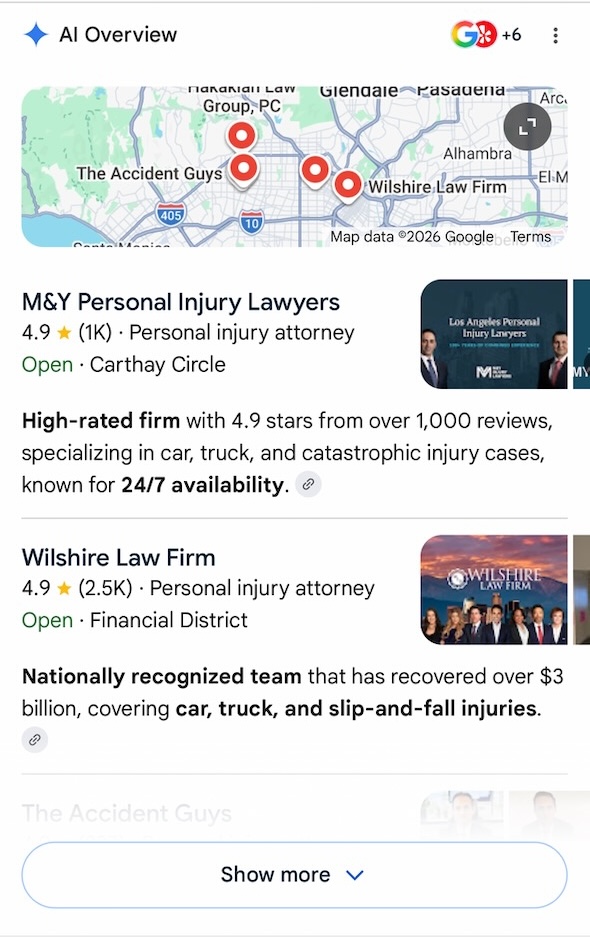
Traditional local search worked in a fairly predictable way. Someone searched “attorney near me,” Google matched that query to their physical location, and a local pack of 3 businesses appeared based largely on proximity, relevance, and prominence. If you understood the ranking factors, you could reasonably predict where you’d show up.
AI Mode works differently, and the data on how differently is starting to come into focus. Analysis of ranking reports across hundreds of markets found that AI-powered local packs typically feature only 1 or 2 businesses instead of the traditional 3, often without a call button, and frequently surface different businesses than the ones that ranked in the standard local pack for the same search. Across the markets studied, AI local packs surfaced roughly a third as many unique businesses as traditional 3-packs, and the large majority of those markets saw fewer businesses get visibility overall.
That’s a meaningful shift. It means fewer firms are getting seen at all in AI-driven results, and the firms that do show up aren’t necessarily the ones that would have ranked in a conventional search. On top of that, click-to-call activity from Google Business Profiles has been trending downward for firms even when their rankings haven’t changed, largely because call buttons are being replaced by other formats on mobile. Meanwhile, both local pack ads and Local Services Ads have expanded significantly, which tells us Google is increasingly nudging paid placement into the space organic listings used to own.
There’s also an accuracy risk unique to AI-driven summaries. AI Mode is prone to pulling outdated or mismatched information from across the web. For a law firm, a generated summary that misstates your practice areas, your fee structure, or your consultation process isn’t just inconvenient. It can actively mislead a prospective client, and it raises real questions about accuracy that matter more in legal services than almost any other local business category.
The takeaway isn’t that traditional local SEO no longer matters. It absolutely still does. But AI Mode adds a new layer on top of it, one that rewards firms with a broad, accurate, and consistent digital footprint across many more sources than Google alone, and one where fewer firms are getting a share of visibility in the first place.
- AI local packs often show only 1–2 businesses, not the traditional 3
- Many don’t include a call button at all
- They frequently feature different businesses than the standard local pack
- Overall, they surface far fewer unique businesses across a given market
- Local pack ads and Local Services Ads have both expanded significantly, taking up more of the space organic listings used to hold
Why This Matters More Than Ever
Clients searching for legal help are often making a decision under pressure, whether that’s a time-sensitive matter or simply the stress of navigating an unfamiliar legal process. They’re less likely to click through 10 blue links and compare firms side by side, and more likely to ask a conversational question and trust the first clear, reassuring answer they get.
That shift raises the stakes for accuracy, depth, and diversification. If AI Mode is summarizing your firm based on outdated directory listings or a competitor’s more complete FAQ page, you could be losing leads you never even knew you were competing for. And if fewer firms are getting featured in AI local packs to begin with, standing out requires more than the basics. Here’s how to build the kind of digital presence that gives you the best shot at showing up, and showing up accurately.
1. Get Your Google Business Profile Doing More Work
Your GBP has always mattered for local visibility, but it’s now one of the primary sources AI Mode pulls from directly, including for the summaries that appear when someone clicks into your listing. A thin or outdated profile gives Google less accurate material to work with, which increases the odds it fills in gaps with information from elsewhere, sometimes incorrectly.
Make sure your GBP includes:
- Complete and accurate practice areas, not just “Law Firm” as a category
- Regularly updated photos of your office, team, and community involvement
- Posts published consistently, not just set up once and forgotten
- A filled-out Q&A section addressing the questions clients actually ask
- Hours, phone number, and address that match your website exactly
That last point matters more than it sounds. Inconsistent name, address, and phone (NAP) information across your GBP, website, and directory listings creates the kind of conflicting data that AI tools are most likely to get wrong.
2. Expand Beyond Google: Directories and Yelp
AI Mode frequently cites review platforms and legal directories directly, especially for branded searches where someone asks about your firm by name. That means your presence on sites like Avvo, FindLaw, Justia, and Yelp isn’t just a nice-to-have for organic growth. It’s a direct input into what AI tools tell prospective clients about you, and with fewer firms getting featured in AI local packs overall, a strong presence across multiple platforms gives you more chances to be the source AI pulls from.
For Yelp specifically, don’t treat it as an afterthought. Keep your profile current, respond to reviews, and add photos regularly. If your local market has “best of” or “top attorney” lists on Yelp or similar platforms, ask whether your firm qualifies for inclusion. These curated lists are exactly the kind of source AI Mode tends to lean on when summarizing options in a given market.
3. Build Out FAQ Content in the Language Clients Actually Use
AI Mode is conversational, which means it’s optimized to answer questions, not match keywords. If your website’s content is built around search terms but doesn’t actually answer the questions clients are asking, you’re leaving a gap that a competitor’s FAQ page can fill instead.
This is especially important given what’s happening to informational content more broadly. Many businesses that have invested heavily in blog and article content have seen real declines in traffic to those pages as AI Overviews answer questions directly in the search results. That doesn’t mean this content has stopped working. It still strengthens the pages on your site that actually generate leads, and it’s exactly the kind of material AI tools pull from when assembling an answer. The strategy shift is to write content your competitors haven’t already written, rather than duplicating what’s already ranking.
Start by asking your intake team what questions come up most often, in the client’s own words. Then build genuine FAQ content around those questions, on your website and ideally reflected in your GBP Q&A section as well. This is one of the highest-leverage moves available right now, because it directly feeds both traditional SEO and AI-driven search (GEO and AEO, or AI Search) at the same time.
- Pull real questions from your intake team, not guesses
- Answer in plain language, the way a client would actually ask
- Publish the same core questions on your website and in your GBP Q&A section
- Write about angles your competitors haven’t already covered
- Update FAQ content as your practice areas or processes change
4. Create Unique, Specific Practice Area Pages
Generic practice area pages that could belong to any firm in the country don’t give AI tools, or human readers, much to work with when trying to differentiate you. A strong practice area page should answer: What makes your approach to this issue different? What experience does your team bring? What should someone expect from the process?
The goal is depth and specificity, not just checking a box that says you handle a given matter. The more clearly your website explains your actual approach, the more accurately AI tools, and prospective clients, can represent what sets your firm apart.
5. Invest in Reviews and Reputation, Continuously
Reviews have become one of the most heavily cited sources in AI-driven local search results. This means your reputation management strategy needs to be ongoing, not something you revisit once a quarter.
- Request reviews consistently, not just after a case closes
- Respond to every review, positive and negative
- Treat negative feedback as a chance to demonstrate responsiveness publicly
- Keep review volume and recency steady across the year, not clustered
- Monitor reviews across Google, Yelp, and legal directories, not just one platform
6. Don’t Overlook Unstructured Mentions
Beyond directories and reviews, AI Mode also pulls from what’s often called “unstructured citations”: mentions of your firm on local news sites, community organization pages, sponsorship listings, and industry publications. Getting your firm mentioned outside your own website, through community involvement, local press, or contributed articles, builds the kind of broad digital footprint that AI tools draw from when assembling an answer.
7. Lean Into Video, and Diversify Where You Show Up
Video remains one of the most effective trust-building tools available to law firms, and it’s increasingly showing up as a factor in how AI-driven search results present local businesses. Focus on consistently using video here to build trust: short, regular content like attorney introductions, answers to common questions, and client testimonials (with permission) helps humanize your firm in a way that static text can’t.
This also fits a broader pattern worth paying attention to. As AI Overviews and AI local packs absorb more of the traffic that used to go to organic listings, platforms like YouTube and even community forums like Reddit are becoming meaningful places to build authority and visibility outside of Google’s traditional search results. This is a longer-term play, but it’s one of the more durable strategies as more of the internet gets filtered through AI. Video content gives you a natural way to show up in those spaces while reinforcing the same FAQ and practice area content driving your broader strategy.
8. Track Where Your Traffic Is Actually Coming From
With so much shifting at once, it’s worth setting up basic tracking for how much of your website traffic is coming from AI tools like ChatGPT, versus traditional Google search. For most businesses today, AI referral traffic is still a small fraction of what Google sends, but it’s growing, and the businesses that get ahead of measuring it now will be better positioned to adjust as it becomes a bigger piece of the picture.
The Bottom Line
Traditional local SEO isn’t going anywhere, but it’s no longer the whole picture, and it’s no longer guaranteed to put your firm in front of as many prospective clients as it used to. AI Mode rewards firms that show up accurately and consistently across a wide range of sources: your website, your GBP, review platforms, legal directories, video, and the broader web. Getting this right isn’t just about visibility, it’s about making sure the information a prospective client finds about your firm is actually true, and that your firm has more than one path to being found.
This is exactly the kind of shift where a legal-specific marketing partner earns its keep. General marketing agencies are still catching up on what AI search means for local businesses broadly, while an agency built exclusively around law firms understands what clients are actually searching for, and how to build the presence that answers them accurately.
If you want a clear-eyed look at where your firm currently stands in AI-driven local search, reach out to LegalScapes for a conversation about your specific market and practice areas.