Attorneys are using AI to draft correspondence, summarize depositions, research case law, and speed up intake. Staff are experimenting with tools to write social posts, respond to client emails, and organize case files. Some of this is happening with a firm’s knowledge and approval. A lot of it is happening quietly, without any guardrails at all.
That gap — between how AI is actually being used and whether anyone has set rules for it — is where firms run into trouble. A formal AI use policy closes that gap. It is not about restricting innovation. It is about making sure the firm stays in control of how AI fits into its work, so the firm can benefit from the technology without exposing itself to risk it never agreed to take on.
Why an AI Use Policy Matters
Client Confidentiality Is on the Line
Many popular AI tools were not built with attorney-client privilege in mind. When someone pastes case details, client names, or sensitive facts into a public AI tool, that information may be stored, used to train future models, or exposed in ways the firm never intended. A policy establishes which tools are approved for firm use and what information can never be entered into them.
Accuracy and Competence Are Non-Negotiable
AI tools can produce writing that sounds confident and reads well, even when it is wrong. There have been well-publicized cases of attorneys submitting briefs with fabricated case citations generated by AI. Courts have not been forgiving. Bar associations across the country have issued guidance making clear that the duty of competence extends to understanding the tools an attorney uses, including AI.
Courts have sanctioned attorneys for submitting AI-generated briefs containing citations to cases that do not exist. The AI produced plausible-sounding case names and quotes. The attorney did not verify them. The bar associations’ position is consistent: the duty of competence applies to every tool an attorney uses, and AI is no exception.
Consistency Protects the Firm’s Reputation
Without a policy, different attorneys and staff members will make different judgment calls about what is appropriate. One person might feel comfortable using AI to draft a demand letter. Another might use it to respond to a grieving client. A policy creates a consistent standard across the organization so the firm’s voice, judgment, and reputation stay intact no matter who is using the tool.
It Signals Maturity to Clients and Courts
A written policy shows that a firm has thought seriously about how it uses new technology. That matters to clients who are increasingly asking firms how their information is handled, and it matters to courts that are watching closely for AI missteps in legal filings.
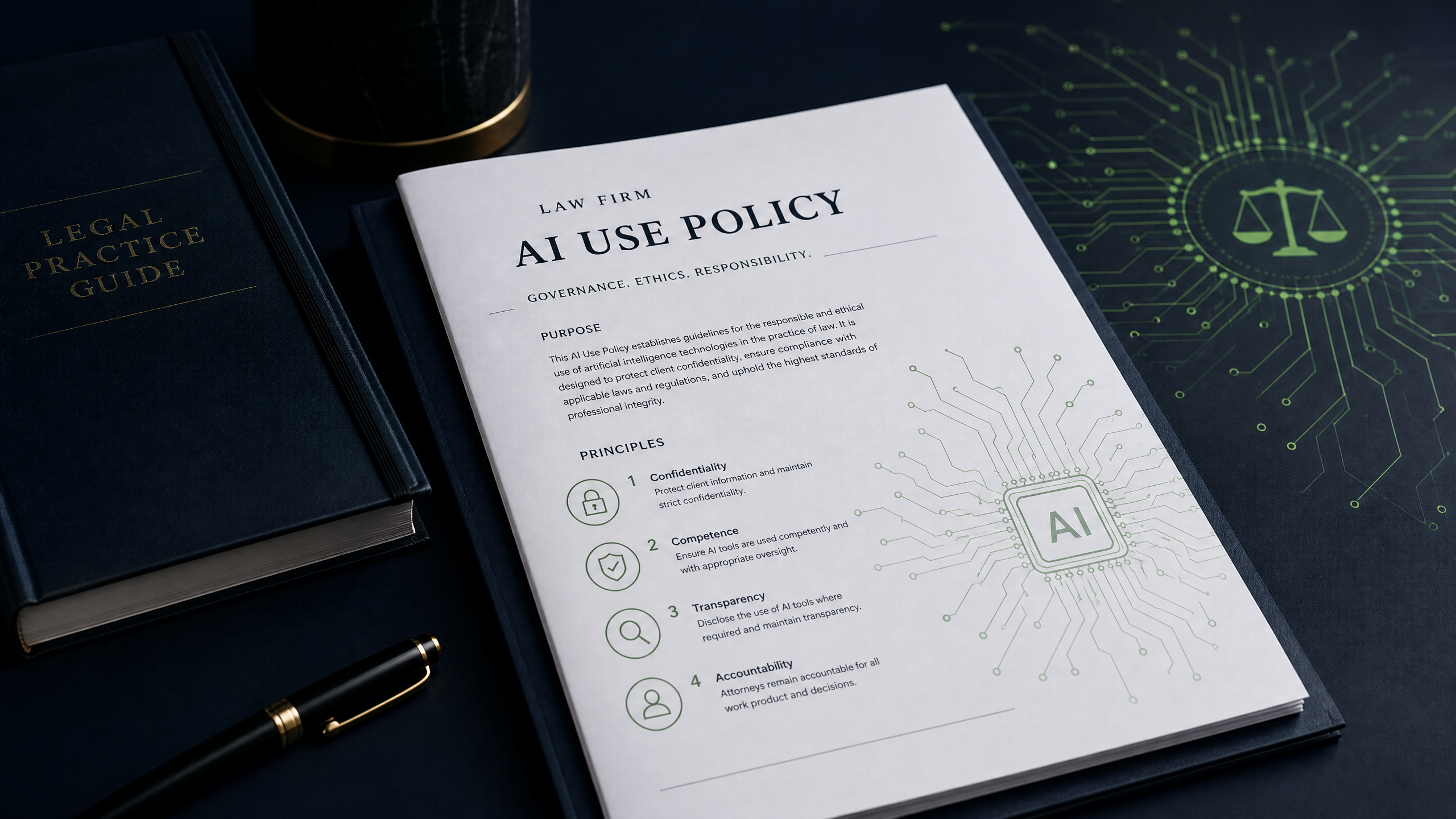
What a Sample AI Use Policy Might Include
Every firm’s policy should be tailored to its practice areas, workflows, and risk tolerance, but most effective policies cover the same core ground. Here is a simplified framework a firm might build from:
Purpose and Scope
A short statement explaining why the policy exists and who it applies to — attorneys, paralegals, intake staff, marketing team, and any contractors who touch firm data.
Approved Tools
A specific list of AI tools the firm permits, along with a note that any tool not on the list requires approval before use. This prevents the “shadow AI” problem, where staff quietly adopt tools the firm has never vetted.
Confidentiality Rules
Clear direction on what information can never be entered into an AI tool — client names, case specifics, medical records, financial details, or anything covered by privilege.
Human Review Requirement
AI can draft, summarize, brainstorm, and accelerate. It cannot be the final word on anything that goes in front of a client, opposing counsel, or a court. Every piece of AI-assisted work must be reviewed and approved by a qualified person.
Use Case Guidelines
Specific direction by task. AI may be appropriate for drafting a first-pass client update email, but not for making legal judgment calls about a case’s strategy.
Disclosure Expectations
Guidance on when and how the firm discloses AI use — whether to clients, courts, or in marketing materials — based on applicable rules and the firm’s values around transparency.
Training and Updates
A note that the policy will be reviewed regularly, since AI tools and the guidance around them are changing quickly. What is best practice today may need revision in six months.
Accountability
A clear statement that using an AI tool does not shift responsibility away from the person who used it. If a mistake makes it into a filing or email, the human who reviewed and approved it owns that outcome.
The human review requirement is the section that matters most, and it should never be watered down. The firm, not the tool, is accountable for the final product. Every policy can be summarized in one sentence: AI can generate, but a qualified human always reviews, verifies, and takes responsibility for what goes out the door.
Rolling Out the Policy
Writing the policy is the easier part. Getting a team to actually follow it takes intention. A few suggestions for a smooth rollout:
Start with a conversation, not a memo
Before the policy lands in anyone’s inbox, walk the team through why it exists. People are far more likely to follow rules they understand the reasoning behind, especially when it comes to something as fast-moving as AI.
Get input from the people actually using the tools
The attorneys and staff already experimenting with AI often know more about the practical realities than firm leadership does. Ask them what they are using, what has worked, and where they have had concerns. This builds buy-in and often surfaces issues leadership had not considered.
Make the human review rule impossible to miss
Every training session, every reminder, every internal document about AI use should reinforce the same point: AI can generate, but a person is always accountable for what goes out the door. Repetition matters here more than almost anywhere else in the policy.
Provide a short, practical guide alongside the formal policy
A one-page cheat sheet with approved tools, quick do’s and don’ts, and who to ask with questions will get used far more often than the full policy document.
Designate a point person
Someone on the team — whether that is an office manager, a partner, or an outside advisor — should own questions about AI use as they come up. Policies that live only on paper tend to get ignored the first time a real question arises.
Revisit it on a schedule
Set a calendar reminder to review the policy every 6 months. AI tools, court guidance, and bar association rules are all evolving, and a policy that was solid a year ago may already have gaps.
The Bottom Line
AI is not going away, and firms that ignore it are not avoiding risk — they are just choosing to manage it poorly instead of well. A thoughtful AI use policy gives a firm a way to capture the real efficiency gains AI offers while protecting what matters most: client trust, professional accountability, and the quality of the work that carries the firm’s name.
The core principle is simple enough to fit on an index card. AI can help generate the first draft. A qualified human always reviews it, verifies it, and takes responsibility for what goes out. Firms that build their policy around that idea will be well positioned no matter how the technology develops from here.